Bernardim Freire de Andrade
Command Ratings
Bernardim Freire de Andrade—often referred to in contemporary and later accounts as Bernardim Freire or Bernardino Freire—was born in Lisbon on 18 February 1759 and became one of the senior Portuguese general officers of the opening phase of the Peninsular War. His full formal name in Portuguese sources appears as Bernardim (or Bernardino) Freire de Andrade e Castro. Entering the army in the late ancien-régime period, he built his career in the line infantry, rose through regimental grades during the Revolutionary wars in the Pyrenees, and by 1807 held high territorial command in northern Portugal. In 1808–1809 he became a central figure in the attempted reconstitution of the Portuguese field army after the first French occupation, before being killed at Braga on 17 March 1809 by elements of the very forces he commanded, during the crisis preceding Marshal Soult’s advance on Oporto.
Freire’s recorded service began in 1781, when he enlisted as a cadet in the Regimento de Infantaria de Peniche, then in the Lisbon garrison. He was promoted alferes (ensign) on 25 April 1782 and placed in the regiment’s 5th company, then promoted tenente (lieutenant) in the same company on 9 October 1782. His further promotions in the regiment followed: capitão (captain) on 27 April 1787, major on 27 February 1790, and tenente-coronel (lieutenant-colonel) on 24 September 1791. Through these years he remained in the Peniche infantry regiment and in Lisbon postings, a pattern characteristic of Portuguese officers whose careers were shaped by garrison duty until war service opened opportunities for accelerated advancement.
The outbreak of war against Revolutionary France and the subsequent Iberian operations brought Freire to field service. In 1793 he was sent to Catalonia with the Portuguese contingent serving as the Exército Auxiliar à Coroa de Espanha, cooperating with Spanish forces in the Roussillon theatre. His wartime promotions continued: he became coronel (colonel) of the Peniche infantry regiment on 17 December 1794 and was promoted brigadeiro (brigadier) on 25 January 1795. Accounts place his active service in the Roussillon operations in 1794–1795, when Portuguese forces participated alongside Spanish formations against French armies operating on the eastern Pyrenean front; this combat experience remained the principal “continental” campaigning of his early career and formed part of the credentials later cited when he was entrusted with senior command in the emergency of 1808–1809.
In the aftermath of Portugal’s defeat in the brief War of the Oranges (April–June 1801), the Portuguese state undertook renewed attempts at military reform and restructuring. Freire’s documented later career includes participation in commissions formed in the reform context that followed the 1801 setback. By 25 February 1807 he had reached the senior rank of marechal-de-campo (field marshal in the Portuguese usage of the period), and on the same date he was appointed Governador das Armas of the military region of Porto (the Partido do Porto), a key territorial command responsible for the northern approaches and the mobilization of regional forces.
The French invasion of Portugal under General Jean-Andoche Junot in November 1807, and the political paralysis that followed the royal court’s departure for Brazil, disrupted the Portuguese military system. With the metropolitan authorities ordering avoidance of direct resistance in the initial occupation phase, Freire sought and obtained authorization from the Council of Regency to withdraw from active service, retiring to Coimbra in the company of his cousin Miguel Pereira Forjaz, who later became a leading administrative figure in the Portuguese war effort. This withdrawal did not end his public military role for long. The revolt that spread from Spain after 2 May 1808 and the consequent Portuguese insurrections rapidly recreated conditions in which experienced senior officers were urgently required.
In the summer of 1808 Freire re-emerged as a senior commander within the insurgent framework that formed in northern Portugal. On 22 July 1808 he was appointed commander-in-chief of the Portuguese forces in the north by the Supreme Junta of Oporto, and he is also listed as commandant of an “Army of Operations in Estremadura” from that date in some structured command lists. In practice his responsibilities in 1808 combined territorial command at Porto with the organization of field forces intended both to cooperate with the arriving British expeditionary army and to secure northern Portugal against renewed French thrusts. Portuguese and foreign accounts of the period repeatedly connect his name to the reconstitution of units, the recovery of matériel left from the Junot occupation period, and the attempt to create workable formations out of a mixture of regular battalions, militia, and ordenanças.
Freire’s political and military posture in 1808 placed him in a difficult relationship with British commanders and with local Portuguese political forces. After the Anglo-Portuguese victory at Vimeiro (21 August 1808) and the Convention of Cintra (signed at the end of August 1808), Freire became an outspoken critic of the terms that allowed Junot’s army to evacuate Portugal. In parallel, British commanders found him a challenging counterpart. These tensions did not remove him from command; rather, they framed his position as a senior Portuguese general whose authority rested on national institutions and local juntas at a moment when coalition command arrangements were still unsettled.
Freire’s rank continued to advance. He was promoted tenente-general (lieutenant-general) on 2 October 1808, the highest Portuguese army grade in the contemporary structure as cited in several Portuguese and French-language summaries. Through late 1808 and into early 1809, with the expectation of a renewed French offensive, his responsibility remained the defense of northern Portugal—particularly the Minho region and the approaches to Oporto—against the projected second invasion.
That invasion began when Marshal Jean-de-Dieu Soult entered northern Portugal from Galicia in March 1809. Freire assembled a large Portuguese force around Braga, composed of a core of better-armed troops alongside extensive ordenança levies and local militia. Charles Oman’s detailed narrative of Soult’s invasion describes the strategic fault of leaving the mountain defiles of the Serra da Cabrera insufficiently held while concentrating the main mass near Braga, and he records the corrosive crisis of discipline and rumor that pervaded the Portuguese camp as Soult approached. In Oman’s account, Freire—under threats from within his own force and facing near-hysterical accusations of treason—attempted to quit Braga secretly to withdraw toward Oporto, was seized by ordenanças near Tobossa, and was brought back to the camp as a prisoner.
The immediate collapse of his authority produced a rapid and violent change of command. Oman records that Christian Adolph Friedrich Eben (Baron Eben), Colonel associated with the 2nd Battalion of the Loyal Lusitanian Legion and acting as Freire’s second-in-command, assumed control of the army and consigned Freire to the jail of Braga. There, on 17 March 1809, Freire was dragged out by ordenança men and killed in the street with pikes; in the same outbreak, Major Villasboas (identified as the chief of engineers in English summaries) and other staff officers were also murdered. Freire’s death thus occurred three days before the Battle of Braga (20 March 1809), in which Soult’s French corps defeated the Portuguese forces now directed by Baron Eben.
Freire’s career, although cut short before he could command a reorganized Portuguese field army in sustained operations, remained closely tied to the critical transition from the disordered forces of 1808 to the later, more disciplined Portuguese army created under British direction. His death at Braga—an internal military and political catastrophe at the moment of a French offensive—became one of the most notorious episodes of the Portuguese war, illustrating the fragility of command over partially mobilized provincial forces and the lethal consequences of rumor and faction when confronted with an experienced enemy advance.
Sources
- Wikipedia (English): Bernardim Freire de Andrade
- Wikipedia (Portuguese): Bernardim Freire de Andrade
- Project Gutenberg: A History of the Peninsular War, Vol. II (Charles Oman, 1903)
- Wikipedia (English): Battle of Braga (1809)
- DICHP (Biblioteca Nacional de Portugal): Arquivo Histórico Militar / Boletim reference to António Pedro Vicente study on Bernardim Freire
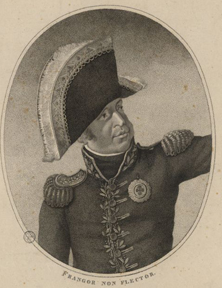
He was reorganizing the Portuguese army when killed by his own troops. XX 93 – Roussillon campaign; X 08 Vimiero and then killed by his own troops. (1764-1809)