Jean-Baptiste Bernadotte
Command Ratings
Commands & Units
- Commands the French I Corps at Halle (1806, age 43)
- Commands the IX Corps of French VIII Corps at Linz-Urfahr (1809, age 46)
- Commands the IX Corps of Armée d'Allemagne at Wagram (1809, age 46)
- Commands the Army of the North at Leipzig (1813, age 50)
Jean-Baptiste Bernadotte (also recorded in full Revolutionary-era usage as Jean-Baptiste Jules Bernadotte; later the Swedish crown prince and king as Carl XIV Johan / Charles XIV John) was born at Pau on 26 January 1763 and entered the Bourbon army as a private soldier on 3 September 1780 in the Régiment Royal-La Marine. Advancing in the pre-Revolutionary establishment to senior non-commissioned rank, he was promoted to adjudant-major in early 1790. Commissioned as an officer late in 1791, he entered active service in the wars of the Revolution on the northern and Rhine fronts, and his rapid rise belonged to the generation of officers whose authority rested on field performance and the political confidence of the revolutionary state.
In the campaigns of 1793–1794 Bernadotte served with the Army of the North and then on the Rhine; by 1794 he held general officer rank, being promoted general de brigade during that year and then general de division in October 1794. At Fleurus on 26 June 1794, during the Flanders campaign that secured the Austrian Netherlands for France, he commanded at brigade level and was among those officers whose conduct was credited by later summaries with driving attacks that helped force the enemy withdrawal. Thereafter he was attached to the Army of Sambre-et-Meuse, an army with which his name remained strongly associated through the next phase of the First Coalition war.
During 1795 Bernadotte served as a divisional commander in the Army of Sambre-et-Meuse under Jean-Baptiste Jourdan. In the autumn operations culminating around the Main, his division is documented among the army’s divisional structure on 1 October 1795, deployed on the Rhine line in the Mainz region, and he continued to hold divisional responsibility in the army’s maneuvering between the Lahn, Main, and Rhine. The following year, in the 1796 campaign in Germany, Bernadotte’s division operated during the difficult retreat after reverses in southern Germany. At Theiningen (Deining) on 21–22 August 1796 (often given as 22–23 August in secondary listings), he commanded a French division in a sharply contested rearguard action against Archduke Charles’s forces; accounts emphasize that his handling of withdrawal and counterattacks prevented encirclement and enabled the French retreat toward the Rhine to proceed. Such actions, involving controlled use of infantry squares and artillery positioning to delay superior numbers while securing routes and crossings, were the kind of divisional command problems on which Bernadotte’s early reputation rested.
In 1796–1797 he also served in the Italian theatre, where his record of command contributed to his standing with the Directory. In early 1798 he was sent on a short diplomatic mission as French ambassador to Vienna (February–April 1798), which ended abruptly amid hostile demonstrations and the breakdown of relations; he returned to military employment thereafter. At the opening of the War of the Second Coalition in 1799 he was given an important independent command on the northern Rhine sector around Mannheim, controlling a substantial force in the theatre where Jourdan and others were attempting to hold the line against renewed Austrian pressure. After the French setbacks in southern Germany (including the defeat of Jourdan at Stockach on 25 March 1799), Bernadotte’s command situation deteriorated and he soon left for Paris.
From 2 July 1799 to 14 September 1799 Bernadotte served as Minister of War of the French Republic. His ministerial tenure fell in the terminal crisis of the Directory and in the period of intense pressure on manpower, supply, and internal security. Surviving documentation and later summaries of his ministry link him to efforts to manage the demands of multiple fronts while navigating volatile Paris politics; his tenure ended before Napoleon Bonaparte’s coup of 18 Brumaire (9 November 1799). During the coup crisis he did not commit his military influence in support of Bonaparte’s seizure of power, but he also did not attempt to mobilize force against it, and he remained a significant figure in the reshuffled state.
In the Consulate period Bernadotte entered the Council of State (1800–1802) and returned to high command, being appointed commander of the Army of the West (armée de l’Ouest) in 1800. His term in the West is dated in French army command lists to 3 May–10 October 1800 and again to 5 May 1801–mid-November 1801, during which he was engaged in the consolidation and pacification tasks remaining after the principal phases of the Vendée and Chouan wars. These were commands where the military problem was inseparable from policing, intelligence, and the control of supply and requisition in exhausted departments, and where the state expected a commander to stabilize administration as well as to direct columns in the field.
Bernadotte’s relationship with Napoleon remained uneasy, yet he was brought within the imperial system after the proclamation of the Empire. On 19 May 1804 he was created a maréchal d’Empire and soon afterwards was appointed military and civil governor of Hanover, serving in that post from June 1804 to September 1805. His Hanover administration was widely noted in later accounts for a comparatively measured handling of occupied territory and for attention to administrative order and finance, though it also belonged to the imperial practice of drawing “contributions” from occupied states. Hanover additionally formed the nucleus of the corps he would lead when the Grande Armée marched east in 1805.
On 29 August 1805 Bernadotte took the field as commander of I Corps of the Grande Armée in the War of the Third Coalition. I Corps marched from northern Germany into central Europe as part of Napoleon’s strategic concentration for the Ulm campaign. In the subsequent movement toward Moravia, Bernadotte’s corps operated on routes that required coordination with allied contingents and neighboring corps, and his responsibilities included maintaining march discipline and ensuring supply along extended lines as the army shifted away from its Channel camps. At the Battle of Austerlitz on 2 December 1805, I Corps was positioned in the central sector between the corps of Soult and Lannes; narrative accounts generally describe him as contributing to holding the center and meeting pressure while Napoleon executed the decisive attack against the Allied center-left on the Pratzen Heights. His battle role, while not remembered as dramatic as the central assault executed by Soult’s divisions, placed him in the critical portion of the line where control of intervals and timely reinforcement mattered for maintaining coherence during the Allied attempt to turn the French right.
On 5 June 1806 Napoleon granted Bernadotte the sovereign title Prince of Pontecorvo, creating him Prince de Ponte-Corvo. This elevation placed him among the imperial nobility and coincided with his continued employment as a corps commander. In the War of the Fourth Coalition he again led I Corps. After the twin battles of Jena and Auerstedt on 14 October 1806, controversy attached to his marching and his distance from Davout’s combat at Auerstedt, yet in the immediate pursuit phase Bernadotte conducted active operations against Prussian forces attempting to regroup. On 17 October 1806 he fought and won the Battle of Halle, defeating the Prussian Reserve under the Duke of Württemberg; the engagement involved forcing crossings and entries into the city and driving the enemy into retreat toward the Elbe line. In the subsequent pursuit northward through Mecklenburg and toward the Baltic, Bernadotte’s corps participated in the chase of Blücher’s retreating Prussians, and on 6 November 1806 he was one of the French marshals present in the Battle of Lübeck, where the French pursuit culminated in the capture and destruction of Major remnants of Blücher’s force and the surrender of additional troops on 7 November.
In the winter campaign in Poland and East Prussia (1806–1807), Bernadotte remained in corps command and was engaged in actions around the French communications and bridgeheads. On 25 January 1807 he fought at Mohrungen, where French forces under his leadership and that of Pierre Dupont pressed back Russian advance elements; the fighting is commonly described as being complicated by a cavalry raid against the French supply train, an episode that highlights the vulnerability of corps-level logistics in the dispersed winter operations of that campaign. Later in the same campaign he was wounded at Spanden, an action associated with the defense of a French bridgehead over the Pasłęka, and his injury removed him from the field for a period and contributed to his absence from later Major engagements of that winter.
After the Peace of Tilsit (7–9 July 1807), Bernadotte was appointed on 14 July 1807 as governor of the Hanseatic towns—Lübeck, Hamburg, and Bremen—residing in Hamburg and exercising authority in a strategically important maritime-commercial zone under the Continental System. His governorship lasted until 7 March 1809, when he was reassigned to field command. The Hanseatic post required managing occupation troops, enforcing blockade policy, and dealing with municipal administrations whose economic survival depended on trade; it also gave him a political profile distinct from marshals employed continuously in the Peninsula or central Europe.
In 1809, during the War of the Fifth Coalition, Bernadotte was assigned to command the Saxon IX Corps in the Army of Germany. At Wagram on 5–6 July 1809 he led IX Corps in attacks focused around Deutsch-Wagram. On the first day his assault was delayed while awaiting the arrival of Saxon formations; when the Saxons advanced into the village they encountered determined Austrian infantry and Jäger defense, and the attack lost cohesion in the built-up area under heavy fire. In the aftermath of the battle and under the strain of Napoleon’s dissatisfaction with the performance of the Saxon contingent and the handling of the corps, Bernadotte was relieved of field command. His last significant French appointment followed soon after, when he was given command associated with the Army of the Scheldt (often cited in English as the Army of the Escaut) during the Walcheren crisis period in 1809, though his tenure was brief and did not restore him to the principal operational commands of the Empire.
A decisive rupture in his military career came in 1810 when Swedish politics, seeking a capable heir for the childless Charles XIII, turned to foreign candidates with military credibility. On 21 August 1810, at Örebro, the Riksdag of the Estates elected Bernadotte as Crown Prince of Sweden. Two months later, on 5 November 1810, he was formally adopted by Charles XIII and assumed the Swedish name Carl Johan (Charles John). He was also made generalissimo of the Swedish armed forces and quickly became the dominant political authority in Sweden, acting as regent in practice during the king’s infirmities. This transition transferred him from imperial French marshal to the head of a state whose strategic interests increasingly diverged from Napoleon’s.
From 1812 onward Sweden moved into alignment with Russia and Britain, and Bernadotte became one of the principal coalition commanders in Germany. In the German campaign of 1813 he commanded the Allied Army of the North, a composite force that included Major Prussian components as well as Swedish and Russian formations. Contemporary orders of battle and later compilations describe his army as incorporating the Prussian corps of Bülow and Tauentzien, a Swedish corps under Stedingk, and Russian corps under Winzingerode and Vorontsov, alongside other German allied elements. Bernadotte’s command problem in this theatre lay in coordinating allied corps with different national systems, controlling political constraints on Swedish casualties, and maintaining operational pressure around Berlin while conforming to coalition strategy.
In the opening phase of the autumn campaign, the Army of the North defeated French attempts to seize Berlin. At Großbeeren on 23 August 1813, the Prussian III Corps under Bülow fought the principal battle against Reynier’s Franco-Saxon force while Bernadotte exercised overall command and controlled the concentration and deployment of supporting elements. At Dennewitz on 6 September 1813, when Marshal Ney renewed the advance on Berlin, coalition forces again won a Major victory. In standard accounts Bernadotte’s overall direction shaped the allied dispositions, while the main fighting and decisive blows were delivered by the Prussian corps (notably Bülow, operating also in conjunction with Tauentzien). The outcome ended Napoleon’s Berlin operations and contributed to the further loosening of French control over Germany.
In October 1813 Bernadotte’s Army of the North took part in the Battle of Leipzig (16–19 October 1813), the decisive coalition victory of the German campaign. Orders of battle list Bernadotte as commander of the Army of the North contingents present, including Prussian III Corps under Bülow and a corps-group under Winzingerode, with Swedish forces also included in the army structure. During the battle’s later phases coalition pressure from multiple directions forced Napoleon into retreat. Bernadotte’s position as a former marshal of the Empire gave his coalition role particular political visibility, since he commanded against the army he had once served and did so while pursuing Swedish state objectives.
In 1814, as coalition armies carried the war into the Low Countries and toward France’s northern frontiers, Bernadotte’s broader command responsibilities continued in the north, though his personal presence in the main French theatre was politically constrained by the need to balance Swedish goals—especially Norway—with coalition plans. His military reputation in this period rested less on personal tactical leadership in battle than on high command within coalition structures and on managing national constraints, diplomatic commitments, and army movement in a theatre where war aims differed among allies.
Bernadotte became king on the death of Charles XIII, reigning as King of Sweden and Norway from 5 February 1818 until his death in Stockholm on 8 March 1844. In Swedish official usage he was Carl XIV Johan in Sweden and Carl III Johan in Norway. His dynasty, the House of Bernadotte, continued on the Swedish throne thereafter. In military memory he remains an exceptional case among Napoleon’s marshals: a senior French commander of the Revolutionary and imperial wars who crossed into sovereign rule and ultimately directed coalition operations against France in the culminating campaigns of 1813–1814.
Sources
- Britannica: Charles XIV John
- Wikipedia (English): Charles XIV John
- napoleon.org: BERNADOTTE, Jean-Baptiste-Jules
- Wikipedia (English): Battle of Halle
- Wikipedia (English): Battle of Lübeck
- Wikipedia (English): Battle of Mohrungen
- Wikipedia (English): Battle of Wagram
- Wikipedia (English): Swedish Act of Succession
- The Napoleon Series: Jean-Baptiste Jules Bernadotte, King of Sweden and Norway, Marshal (1804)


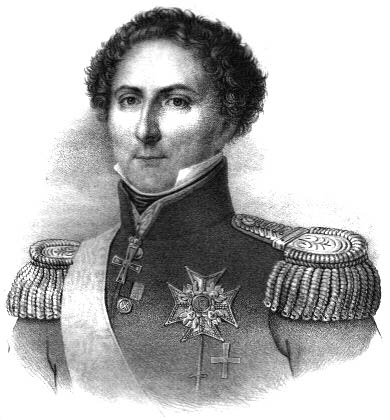
A former sergeant commissioned in 1791, he had "Death to Tyrants" tattooed on his arm. He was the ("Prince of Ponte Corvo") in Napoleon's nobility. He left the French service to become the Crown Prince and actual ruler of Sweden (and later king) and commander of the Swedish army in 1810. X 94 Fleurus; XX 94 (div. rank from 10/94); XX 96 – Sambre-et-Meuse – LW, Wurzburg; XX 97 Italy W; XXXX 99 Army of Observation of the Lower Rhine & a wing of the Army of the Danube; XXXX 00 Army of the West; XXX (I) 05-07 - WW, Austerlitz, missed both Jena & Auerstadt, storming of Lubeck (W), WWW; Spanden (wounded); XXX (IX) 09 – Linz (W), Wagram (disgraced); XXXX (Swedish - with Coalition) 13-14 – Grossbeeren (W), Dennewitz (W), Leipzig (W). (1763-1844)