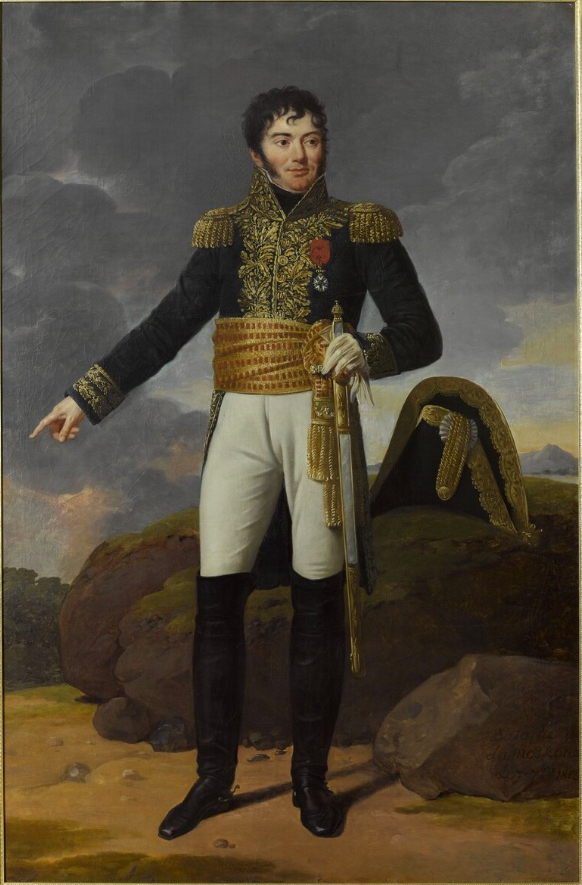
Jean-Victor Tharreau
Command Ratings
Commands & Units
- Commands the First Division of Advance Guard Corps at Aspern-Essling (1809, age 42)
- Commands the Twenty-Third Division of VIII Corps at Borodino (1812, age 45) †
Jean-Victor Tharreau was born on January 15, 1767, in Cholet, France. He began his military career by enlisting in the infantry in 1792 amidst the wars that followed the overthrow of the French monarchy. Quickly rising through the ranks, by 1793 he had become a lieutenant colonel of the 46e demi-brigade and played a significant role in the operations of the Armée de l'Ouest against Vendéan Royalist insurgents, including the siege and capture of Cholet and the subsequent Battle of Savenay in December 1793. His energetic participation in these internal campaigns established his early reputation.
Tharreau transferred to the Armée d'Italie, serving under Napoléon Bonaparte. During the 1796 Italian campaign, he fought at the battles of Lodi, Arcole, and Rivoli, experiencing the intensive military campaigns that characterized the rise of the French military across Europe. He distinguished himself at Rivoli in January 1797. Subsequently, he was present at the siege of Mantua, contributing to the French victory and the capitulation of the Austrian garrison. In 1799, he was attached to the Armée d’Italie during Suvorov’s offensive, taking part in the battles of the Tidone, Trebbia, and Novi. Tharreau was wounded in one of these engagements, yet remained with his command.
Returning to France, Tharreau transferred to the Armée du Rhin under Moreau in 1800. He was engaged at the battles of Engen and Mösskirch in May 1800, and he also fought at Hochstädt and Hohenlinden later that year. At Hohenlinden on December 3, 1800, Tharreau commanded a brigade in Grouchy’s division on the French left, contributing to the victory over the Austrians and cementing his reputation as a capable field officer.
After this, he served in garrison and various command posts before being given further active duty as France reorganized its armies in the wake of the Treaty of Lunéville. Promoted general de division, Tharreau continued his service and was entrusted with several administrative and staff responsibilities until Napoléon’s campaigns resumed. In 1806, he joined the Grande Armée for the campaign against Prussia. Tharreau was present during the Battle of Jena–Auerstedt on October 14, 1806, attached to the VI Corps under Marshal Ney. He took part in the pursuit of the Prussian retreat, with his division involved in the actions around Erfurt and the blockade of Magdeburg, concluding with the city’s capitulation in November 1806.
In 1807, Tharreau participated in the Polish campaign, attached to VI Corps. He fought at the actions preceding and during the Battle of Eylau on February 7–8, 1807, providing support in the center and facing heavy fighting. During this period, he was noted for his role in commanding elements of the corps during the protracted siege of Danzig. After the victory at Friedland on June 14, 1807, Tharreau remained on garrison duty in German and Polish territories while the army was repositioned following the Treaty of Tilsit.
As Napoleon reorganized Europe, Tharreau was appointed chief of staff of the Kingdom of Westphalia under King Jérôme Bonaparte in 1807. For several years, he was engaged in administrative and organizational duties, overseeing the creation and training of the Westphalian Army and participating in the military governance of the new kingdom. In 1809, Tharreau returned to active field command in the campaign against Austria. He led a Westphalian contingent in the campaign along the Elbe and participated in the occupation of Dresden. Although the Westphalians were reserved from the main actions at Aspern-Essling and Wagram, Tharreau's force contributed to securing the French rear areas and logistic lines and suppressed minor uprisings during this period.
In 1812, as the Grande Armée prepared for the invasion of Russia, Tharreau was appointed chief of staff to King Jérôme, commander of the Westphalian contingent assigned to the operation. Tharreau accompanied Jérôme and the Westphalian forces as they crossed the Niemen into Russian territory. During the subsequent advance, he supported the command through the affairs at Grodno and the Pultusk sector. On August 25, 1812, at the Battle of Borodino, Tharreau, continuing in his role despite severe illness, was struck by a cannonball and mortally wounded while observing and supporting operations on the front line with Westphalian troops. He succumbed to his wounds soon after, bringing his career of distinguished service to an end.
Sources
XXX (Corps of the Alps) 00 – W; XX 09 Abensberg-Eckmuhl, Aspern-Essling, Wagram; XX 12 Borodino (KIA)
Pictures