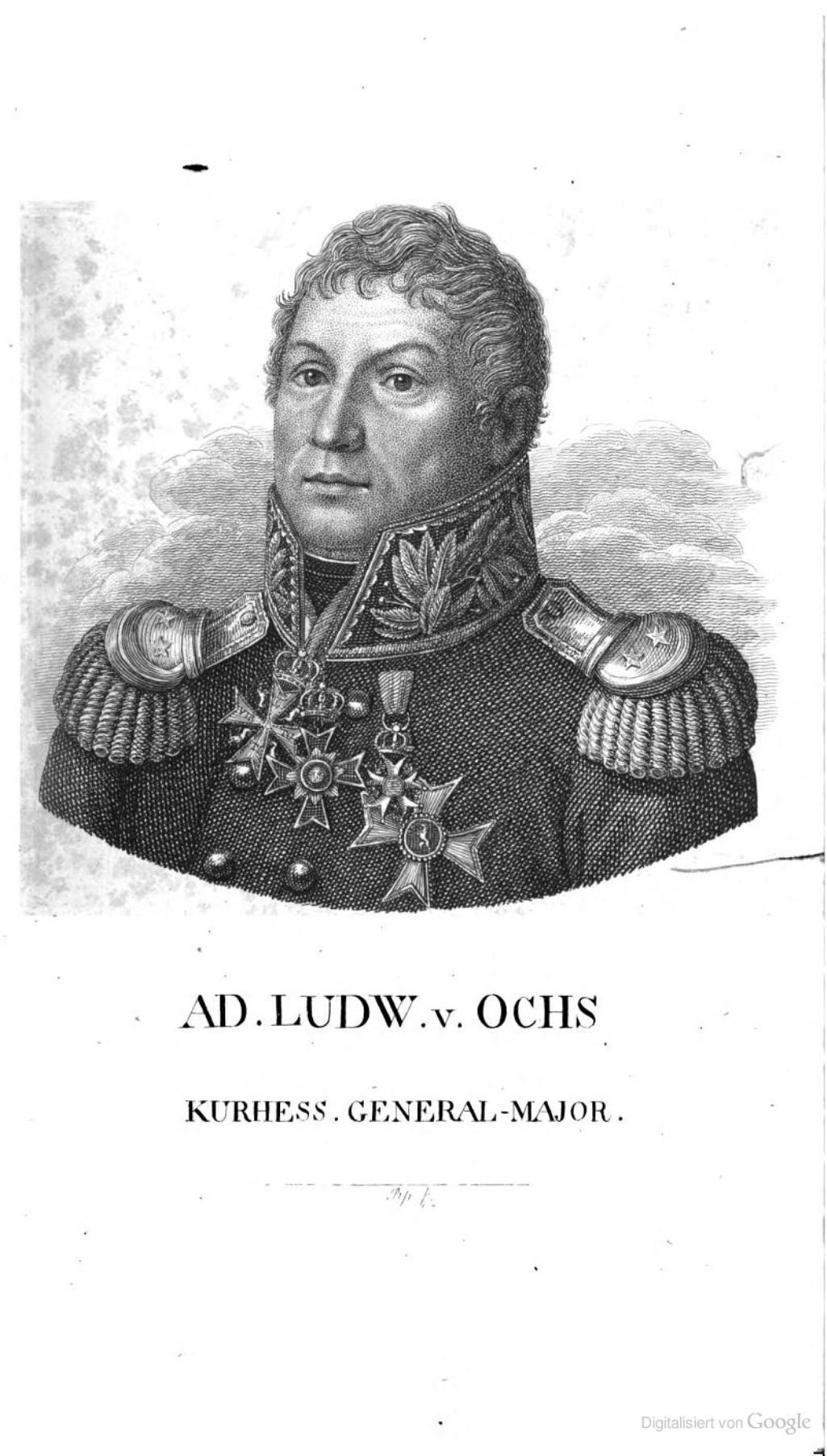
Adam Ludwig von Ochs
Command Ratings
Commands & Units
- Commands the Twenty-Fourth Division of VIII Corps at Borodino (1812, age 53)
Adam Ludwig von Ochs was born on 24 May 1759 in Rosenthal. He entered military service in April 1777 in the Hessian Feldjägerkorps as a Fourier. He served in the American Revolutionary War under Oberst von Wurmb, was promoted to officer on 7 September 1781, and served as Leutnant and adjutant during the campaigns in America. He returned to Europe in 1784. He became Stabscapitän on 11 October 1788 and as the war of 1792 began he commanded a company under his Landgrave in Champagne, participating in the allied assembling near Koblenz. In 1793 during operations against Dunkirk he was detached across the Lys into the enemy rear. In 1798 he helped develop a new Hessian infantry service and drilling regulation, and in 1799 he was promoted to Major and made commander of a Jägerbataillon. On 14 September 1794 he was publicly commended for his conduct at the action at Boxtet. He was elevated to the nobility in 1802 by imperial decree.
By 1805 he was Oberstleutnant and Brigadier of light troops, overseeing the passage of Bernadotte’s corps through Hessen during Napoleon’s advance against Austria. As Generalstabschef he marched toward Fulda with a combined Hessian–Prussian corps, though the campaign did not materialize. After 1806, following the occupation of Kassel by French forces, he entered the service of the Kingdom of Westphalia in December 1807, due to financial necessity. In the Peninsular War of 1809 he was first appointed Oberst and commander of the westphalian brigade. He led about 6,000 men through southern France via Perpignan into Catalonia and distinguished himself during the siege of Gerona in early May, upon which he was promoted to Brigade-General. A fever then forced his return home.
In 1812 he served under the Westphalian corps in the Russian campaign. He took part at Walutino on 18 August, at Borodino and before Mozhaisk on 7 September, where his corps suffered heavy losses; he remained uninjured. His troops could not proceed to Moscow, remaining at Mozhaisk until the general retreat on 28 October. On 15 November at Krasnoe he opened a path through enemy forces, and during the subsequent dissolution of his troops he saved his wounded eldest son in Orsha from capture. Falling ill in Thorn, he was escorted by his son to Posen and then returned to Kassel.
In early 1813 Jérôme appointed him Militärgouverneur of Halberstadt, where he recovered his health. On 30 May 1813 Halberstadt was attacked by Cossacks under Chernyshev; Ochs was wounded, captured, and taken to Dorpat.
After the wars, in 1817 he published in Kassel his Betrachtungen über die neuere Kriegskunst. In 1818 he was commissioned by Elector Wilhelm I to write a Hessian military history. He received honors and lived in moderate means until his death on 21 October 1823 in Kassel.
Sources
Swiss-born. X 10-11 Spain (distinguished record there); XX 12 Lubino, Borodino; XX 13 Halberstadt (captured).
Pictures