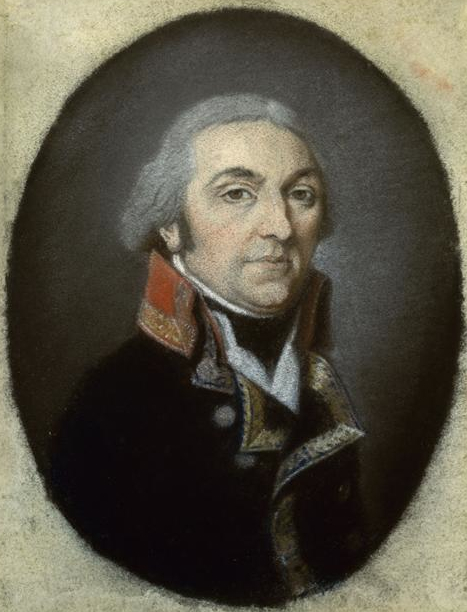
Louis Michel Antoine Sahuc
Command Ratings
Commands & Units
- Commands the Light Cavalry Division of French Army of Italy at Scaile (1809, age 54)
- Commands the Light Cavalry Division of Cavalry Reserve at Piave (1809, age 54)
- Commands the Light Cavalry Division of French Armée d’Italie at Raab (1809, age 54)
- Commands the Armée d'Italie Cavalry of Armée d'Italie at Wagram (1809, age 54)
Louis-Michel-Antoine Sahuc was born at Mello (province of Île-de-France) in January 1755 and entered the royal army on 2 August 1772 as a trooper of the régiment Royal‑Lorraine cavalerie. He received the rank of lieutenant on 30 August 1789. In 1792 he served on the staff of General François Jarry de Vrigny and was present with the Army of the North at the engagement of Valmy on 20 September 1792 and at operations connected with Courtrai; subsequent regimental records associate him and his regiment with the sieges and combats of 1792–1793. He was made chevalier de Saint‑Louis in recognition of his early Revolutionary‑period services and, on 10 July 1794, was appointed chef de brigade (colonel) of the 1er régiment de chasseurs à cheval.
During the later Revolutionary campaigns Sahuc continued in mounted service. Regimental and contemporary accounts place elements under his command at actions recorded in 1796–1797 and again in 1799 during the campaigns in southern Germany and along the Rhine. In 1799 he is reported to have distinguished himself at Emmengen (Emmendingen), where an account records he was wounded by a lance while breaking a body of uhlans and taking prisoners; he was promoted to général de brigade on 21 April 1799. In the spring of 1800 he served in the army operating in southern Germany and Switzerland and is recorded at Engen (3 May 1800) as an active cavalry commander in the encounters that preceded the actions at Ulm. On 3 December 1800 he served as a brigadier in the division of général Antoine Richepance at the battle of Hohenlinden; in the pursuit that followed Hohenlinden he led charges and mounted actions that are recorded at Neumarkt am Wallersee on 16 December, Frankenmarkt on 17 December, Schwanenstadt and Vöcklabruck on 18 December and at Lambach on 19 December, where detachments under his immediate direction took prisoners and matériel during the Austrian retreat.
After the peace of 1801 Sahuc took a seat in the Tribunat, being named to that assembly on 27 March 1802; his parliamentary service continued until the dissolution of the Tribunat, and he acted as questeur of the body. He was invested chevalier de la Légion d'honneur on 26 November 1803 and elevated to commandeur of the order on 14 June 1804. With the renewal of hostilities in 1805 he returned to field service. Napoleon placed him in the cavalry arm: in the autumn of 1805 Sahuc commanded a brigade in the 4th division de dragons of général de division François‑Antoine‑Louis Bourcier, leading the 15e and 17e régiments de dragons (three squadrons per regiment) as part of the cavalry field formations committed to the Ulm and Danube operations. His brigade participated in the movements and combats during the Ulm campaign; contemporaneous orders of battle and regimental returns record his presence at the fighting around Haslach‑Jungingen on 11 October 1805 and with Bourcier’s division at the battle of Austerlitz on 2 December 1805.
Napoleon promoted Sahuc to général de division on 4 January 1806. As a division commander he continued with mounted formations in the Prussian and Polish campaigns of 1806–1807; his division’s marches and actions took it into the pursuit of Prussian forces northward, including the action at Lübeck on 6 November 1806 and later engagements in the winter campaigning season such as Mohrungen (25 January 1807), where French cavalry contingents under divisional commanders were employed in reconnaissance, pursuit and local actions. Official honours followed: he received the title baron de l'Empire on 24 June 1808.
In the spring of 1809 Sahuc was appointed to command a division of cavalerie légère in the Armée d'Italie under the vice‑roi Eugène de Beauharnais. The division’s establishment included chasseurs à cheval regiments and an attached horse‑battery; sources list the 6e hussards and a number of chasseurs regiments among the units that served in the division. On 15 April 1809 Sahuc’s division engaged at Pordenone, where French forces were driven in part by Austrian local superiority; on 16 April the division was held back at the battle of Sacile while Eugène judged the terrain and enemy strength. In early May Sahuc’s cavalry was committed in the operations on the Piave: the 7–8 May action on the Piave River saw the cavalry divisions of Sahuc and of Charles Randon de Pully cross to the right bank while voltigeur and infantry formations crossed the center; the French accounts record a mixed day in which Sahuc’s horsemen repulsed and were counter‑attacked, took artillery and drove Austrian detachments from positions but also suffered casualties when exposed to enemy batteries. In June 1809 Sahuc’s division was present in the advance that brought Eugène to join the Grande Armée; the division is recorded at Raab (14 June 1809) and elements of his command were engaged in the fighting on the Danube approaches. Contemporary returns and regimental war‑records show Sahuc’s cavalry in the field for the culminating fights around the Danube and at Wagram in early July 1809; accounts place his regiments in attacks on 5–6 July and record that he was engaged and wounded during the Italian and Danubian operations of that campaign.
Following the 1809 campaign Sahuc resumed parliamentary duties and was elected to the Corps législatif, serving as deputy for the département of Oise from 1 July 1809 until 1 July 1812. He combined intermittent military duties with his legislative seat: regimental returns and administrative orders show that in 1812 he was given responsibilities relating to depôts and remounts, including an inspection appointment at Limoges and later a post as inspecteur général charged with oversight of dépôts and hospitals in the region between the Rhine and the Oder.
Sahuc’s administrative and inspection commissions continued into 1813. While engaged on duties in the German theatre of supply and inspection he fell ill with typhus and died on 24 October 1813; official parliamentary registers and contemporary biographical dictionaries record his death on that date and list Montmagny (Seine‑et‑Oise / Val‑d'Oise) as the place associated with his household and the place of death recorded in parliamentary returns. His decorations and honours recorded in official rolls include the chevalier de Saint‑Louis, commandeur de la Légion d'honneur, the title baron de l'Empire and the grant of comte in the imperial honours lists; his name appears among the generals inscribed on the monument of the Arc de Triomphe. The chief papers and correspondence of Louis‑Michel‑Antoine Sahuc are preserved in municipal and national collections, among them a collection of his papers catalogued in the Bibliothèque municipale de Coulommiers and listed in national catalogues.
Sources
- Assemblée nationale: Antoine Louis‑Michel Sahuc (Sycomore fiche)
- BnF (CCFr): Papiers du général Louis Michel Antoine Sahuc
- Napoleon Series: French Chasseur‑à‑Cheval Regiments and the Colonels Who Led Them 1791‑1815 (Tony Broughton)
- FrenchEmpire.net: Louis‑Michel‑Antoine Sahuc (biographical entry)
- Wikimedia Commons / Musée de l'Armée: Portrait of General Louis‑Michel‑Antoine Sahuc (pastel)
- Wikipédia (français): Louis Michel Antoine Sahuc

X 00 Hohenlinden; X 05 Haslach-Jungingen; XX 06-07 Jena, Pultusk, Eylau; XX 09 Sacile, Piave, Raab, Wagram
Pictures