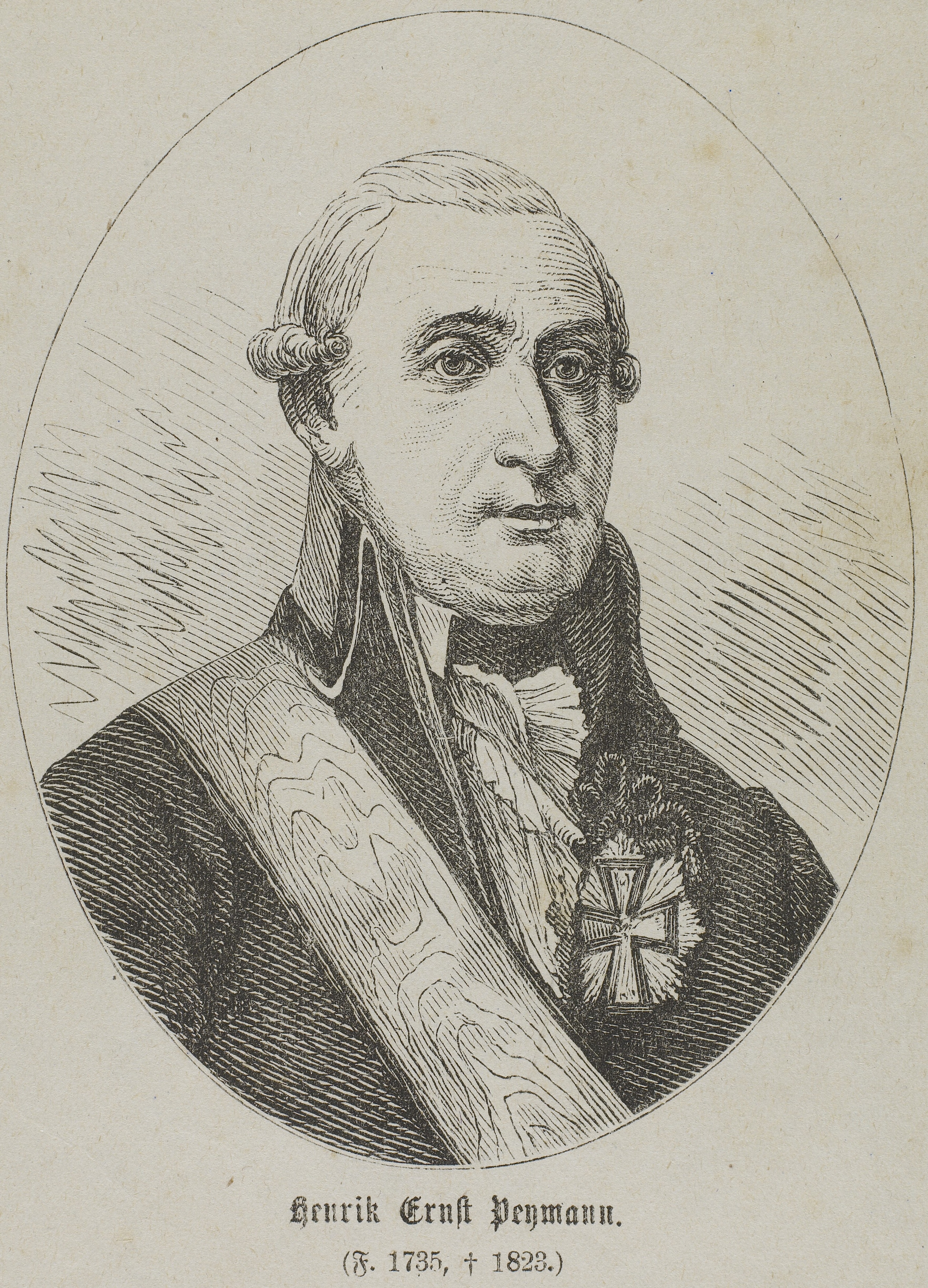
Ernst Peymann
Command Ratings
Hinrich Ernst Peymann (also recorded as Heinrich Ernst Peymann) was born at Rotenburg near Bremen and entered Danish service as a technically trained engineer officer. He began his career in the fortification administration in 1755 as werkbas (works foreman) for the Holstein fortifications, and in the same year became a kar. underkonduktør. During the Seven Years’ War he spent a period accompanying the French army, an experience that broadened his exposure to contemporary field and siege practice even though his own Danish employment remained anchored in engineering and construction work. In 1762, during the Danish mobilization, he was assigned to staff service as a kar. ingeniørkaptajn. When the Ingeniørkorpset was established in 1763, Peymann entered it as konduktør, advanced to overkonduktør in 1766, and in 1770 became kar. virkelig ingeniørkaptajn. His duties in these decades were predominantly connected to design, planning, and oversight of military and state building works rather than troop leadership.
From 1771 to 1772 Peymann represented the land forces in the Overbygningskommissionen, which from 1772 became part of the General-bygningsdirektionen, and he continued thereafter within the building administration until 1796. In 1783 he was promoted kar. ingeniørmajor and in the same year became generalkvartermester at the fortifications in Denmark. His architectural and engineering responsibilities included the construction of a lighthouse on Anholt in 1783 and, in Copenhagen, involvement in the rebuilding and conversion of the Royal Danish Life Guard’s barracks by Rosenborg (Livgardens kaserne ved Rosenborg) in the mid-1780s, as well as construction of warehouses in Toldbodgade, works that reflected the dual military and civil character of Danish fortification and building administration in this era. By the end of the 1790s Peymann was resident at Kastellet in Copenhagen, and he remained closely tied to the capital’s defensive infrastructure and garrison environment rather than to field formations.
Despite a career spent primarily in engineering and administration, Peymann was drawn into senior command as Denmark’s security situation deteriorated in 1807. In May 1807, owing to the illness of Generalmajor H. C. Gedde, Peymann was given command over the military forces on Sjælland. On 11 August 1807, during the crown prince’s hurried visit to Copenhagen amid escalating tension with Britain, Peymann was entrusted with command of the city’s defense but without authority to negotiate with the enemy. In the weeks that followed, British forces landed on Sjælland and moved to isolate Copenhagen while a British fleet imposed naval pressure; the Danish garrison and militia resources available to Peymann were limited in quantity and quality compared with the expeditionary force and its supporting fleet.
Peymann’s verifiable combat participation is tied to the siege and bombardment of Copenhagen in 1807. During the British landing and investment of the city, actions around Copenhagen included engagements on Sjælland that formed part of the tightening ring around the capital, notably the Battle of Køge on 29 August 1807 (also called the “Clogs Battle”), fought between British troops and Danish militia raised on Zealand while Copenhagen was under threat. Within Copenhagen itself, clashes associated with the siege included fighting at Classens Have (29–31 August 1807), where the area was contested and damaged during the investment. The central engagement of Peymann’s military career came with the Bombardment of Copenhagen, which began on 2 September 1807 and continued through the nights of 2–4 September as British forces employed heavy bombardment against the city. As the bombardment and siege progressed, Peymann presided over the defense and the city’s attempts to endure the assault, while the political and military leadership outside Copenhagen debated the strategic crisis created by Britain’s demand regarding the Dano-Norwegian fleet.
As the situation became untenable, peace negotiations were opened. On 6 September 1807 a war council was convened around Peymann during his illness, bringing together senior military and civilian authorities to decide whether to negotiate. On 7 September 1807 the capitulation was signed, and it was confirmed at the British headquarters at Hellerup. The surrender included acceptance of British terms that resulted in the transfer of the Dano-Norwegian fleet, and the British subsequently removed or destroyed naval assets as they prepared the captured ships for departure. Peymann’s role as commander of Copenhagen at the moment of capitulation became the central issue of his later legal and administrative treatment. Accounts in Danish and German biographical references and narrative summaries describe that he was wounded during the bombardment and that he acted under acute pressure from the city’s leadership and circumstances created by the bombardment. After the surrender, by 10 September 1807 Peymann was seriously ill and handed command to Oberst Carl Friederich Bielefeldt.
The political consequences for Peymann were severe. In November 1807 he and other senior officers were brought before an overkrigskommission; in July 1808 he was arrested, and on 16 November 1808 he was sentenced to forfeit honor, life, and property. The sentence was published in January 1809 but was mitigated to dismissal in disgrace without pension and to restrictions connected with Kastellet; he later recovered his seized fortune and was released. He lived for a period in Flensborg after his release, and in later years he was restored to favor sufficiently to be granted a pension. Peymann never married and spent his final years at the fortress of Rendsborg with his brother, who also held general rank in Danish service. He died at Rendsborg on 28 January 1823 and was buried there.
Sources
XX 03 in Hanover; XX (5000) 07 defense of Copenhagen
Military Career
- 1762 kaptajn
- 1770 kaptajn
- 1783 Major
- 1789 Oberst
- 1793 Major
- 1795 General-Major
Pictures