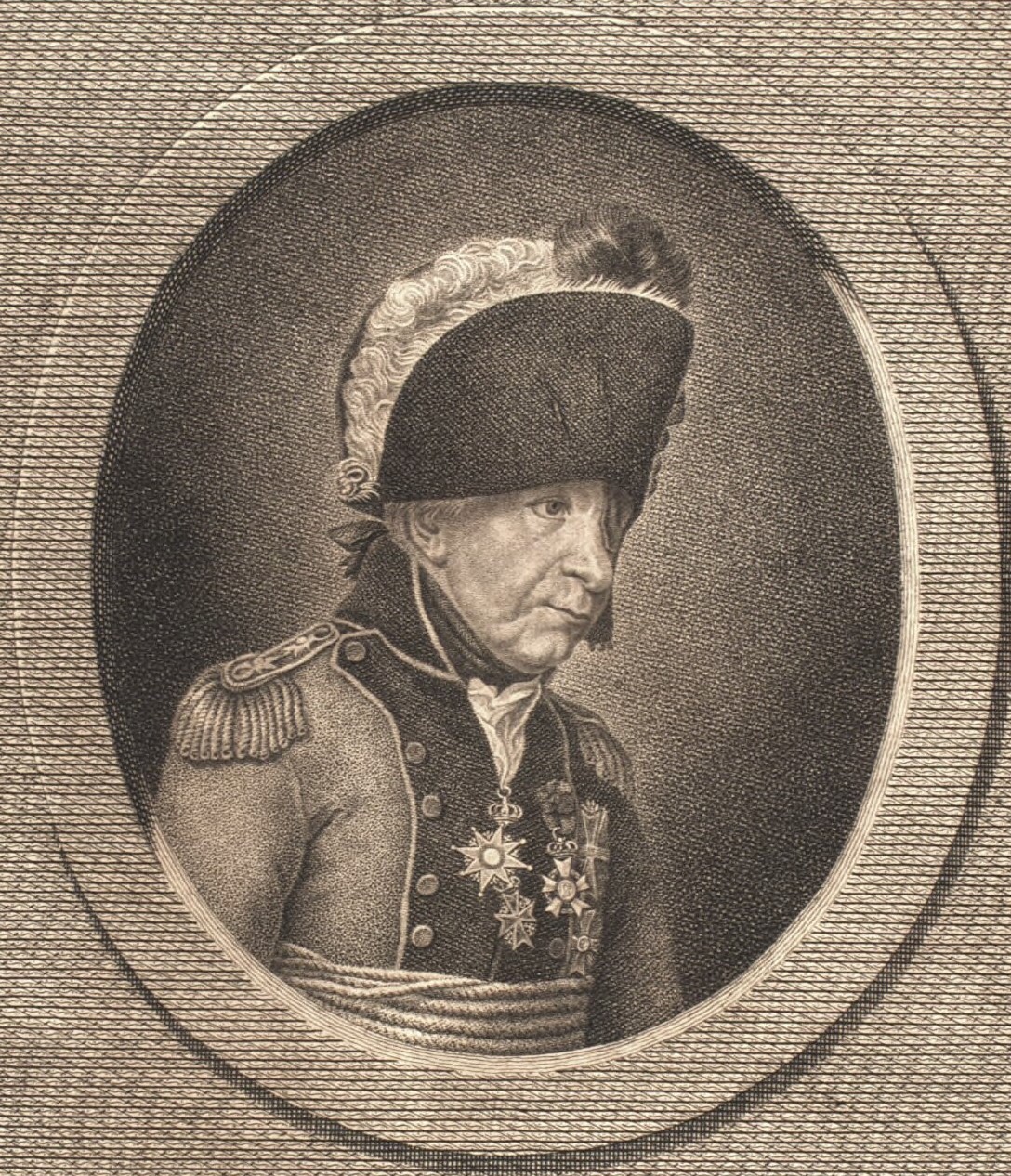
Johann von Ewald
Command Ratings
Johann von Ewald (also Johann Ewald) was born in Kassel on 31 March 1744 and died near Kiel on 25 June 1813. He entered military service in Hesse-Kassel as a cadet in an infantry regiment in 1760 and began an early active-service record during the Seven Years’ War. In the same year he was wounded during the siege of Kassel and was promoted to Fähnrich. He became sekondløjtnant in 1766. While stationed in garrison at Kassel in 1770, he lost his left eye in a duel, and during recovery pursued intensive study of military science. In 1774 he published a treatise on the conduct of a detachment in the field, which brought him favor at court, promotion to captain, and command of a Jäger company.
In 1776 Ewald sailed with his Jäger company as part of the Hesse-Kassel contingent hired by Britain for service in North America. He arrived in New York in October 1776 and took part in the Battle of White Plains. During the winter operations in New Jersey he participated in the Mount Holly action and then in the fighting around Trenton, including the engagement on the Assunpink Creek. In the spring of 1777 he helped plan and took part in the Bound Brook raid (13 April 1777), and later served through the foraging operations and skirmishing that characterized the Forage War. In the same campaigning year he fought at the Battle of Short Hills and at the Battle of Cooch’s Bridge, and then was engaged at the Battle of Brandywine, the Battle of Germantown, and the Battle of Red Bank. In the late-1777 and 1778 sequence of operations around Philadelphia he participated at the Battle of White Marsh and at the Battle of Barren Hill, and then at the Battle of Monmouth. In 1781 he fought at Spencer’s Ordinary and was captured at the Siege of Yorktown.
Ewald returned to Hesse-Kassel in 1784 and set down his American experience in the treatise Abhandlung über den kleinen Krieg (published 1785), a work on light troops and the conduct of the “small war” that attracted attention in contemporary professional military circles. In 1788, seeking advancement outside the constraints of the Hessian service, he entered the Danish Army on the recommendation of Prince Carl of Hessen. Commissioned as oberstløjtnant, he was tasked with forming and commanding the Slesvigske jægerkorps in the Duchy of Schleswig, organized and trained according to principles he had developed in his writings. In the Danish service he built the corps into a model light infantry formation and served as a principal instructor and author of Danish light-infantry manuals.
By 1795 he had become kar., and in the following year he was virkelig oberst. His Danish career became increasingly operational during the years of shifting coalitions and armed neutrality in Northern Europe. During the Danish occupation of Hamburg in 1801 he served as commandant of the city. In 1802 he was promoted to generalmajor. In 1803 he was given command of troops sent as the avant-garde of the corps assembled at the Eider and moved toward the southern frontier to support Denmark’s neutrality posture.
On 6 November 1806 he was involved in an armed incident at Lübeck when French troops, in darkness, mistook the green-uniformed Schleswig Jägers for Prussians. The episode escalated to a personal confrontation with Joachim Murat, after which the French withdrew. In 1807, after the action at Køge and Copenhagen’s capitulation, Ewald received orders to move his corps to Lolland-Falster and take over command of the southern islands; he was later sent to Zealand. His troops were designated as the intended avant-garde for a projected landing in Scania in the winter of 1808–1809, an operation that was later abandoned in the spring of 1809.
After the cancellation of the Scania plan, Ewald was sent to the duchies to take measures against a feared British attack on Holstein’s west coast. Although that landing threat did not materialize, he then took part, alongside the French-Dutch general Pierre Guillaume Gratien and acting on his own responsibility, in operations against the Prussian free-corps leader Ferdinand von Schill. Ewald commanded Danish troops in the storming and street fighting at Stralsund on 31 May 1809, an action in which Schill’s force was defeated and Schill was killed. For his conduct in these operations Ewald was promoted to generalløjtnant and appointed commanding general in Holstein.
In 1812 Ewald received command of the “bevægelige armedivision,” a mobile division of about 10,000 men placed under French overall command in Northern Germany. His health deteriorated severely due to malignant asthma, and on 13 April 1813 he relinquished command and retired to his country estate near Kiel. He died at Kiel and was buried in the St. Jürgen cemetery.
Sources
X 09 Baltic; XX July 1812 (a corps-size unit)

https://archive.org/details/EwaldsDIARYOFTHEAMERICANWAR/mode/2up
Military Career
- 1761 Fendrich
- 1766 premierløjtnant
- 1774 kaptajn
- 1788 oberstløjtnant
- 1795 Oberst
- 1802 General-Major
- 1809 generalløjtnant
Pictures