Heinrich Reinhold von Anrep
Command Ratings
Heinrich Reinhold von Anrep (Russian: Роман Карлович Анреп, Roman Karlovich Anrep) was a Baltic German nobleman in Imperial Russian service who attained the rank of general-leitenant and held divisional command during the War of the Fourth Coalition, being killed in action during the Battle of Mohrungen on 25 January 1807. His career combined line service in the mounted arm, field command and staff responsibilities during the late eighteenth-century wars of the Russian Empire, and senior command employment in the opening stages of the 1806–1807 campaign against Napoleon’s forces in East Prussia.
He was born at Kerstenhof (in Livonia) on 2 September 1760 (Gregorian calendar; several Baltic and Russian references also preserve the corresponding Julian date). He belonged to the Livonian branch of the Anrep family, a German-speaking Lutheran noble house long established in the Baltic provinces. German-language biographical summaries identify his father as Karl Gustav von Anrep, an officer in Russian service and hereditary proprietor of several Livonian estates, and his mother as Margarethe Elisabeth, born Baroness Igelström. The Baltic estate context remained a persistent feature of his life: he is repeatedly described in Baltic biographical notices not only by his military rank but also by his connection to Kerstenhof and other properties.
Anrep was educated in the imperial capital’s elite training system. Russian biographical accounts place him in the Page Corps (the Pazheskii korpus) from 1777 to 1781 and record his attendance as a court page in 1780 during Catherine II’s journey to Mogilev. Upon graduation he entered the Guard with officer rank, beginning a conventional imperial career track in which court education was followed by regiment and field service.
His early regimental service was in cavalry, and the surviving summaries emphasize his participation in the Russo‑Swedish War of 1788–1790. By 1788 he had reached oberstleutnant and was in active operations against Sweden. In the summer campaign around the fortress of Nyslott (Savonlinna), he is credited in Russian and German sources with conduct meriting the Order of St. George, 4th class, awarded for service in 1790 connected with fighting at or near the Pirdalashmäki bridge positions during the defense against Swedish operations. This award, reserved for combat distinction, indicates that by the end of the Swedish war he was already regarded as a field officer of recognized gallantry and competence.
In the 1790s, Anrep’s service broadened to include the Polish theaters. German and Russian narratives alike place him in the campaigns connected with the Kościuszko Uprising, and his combat record in this period is linked to a second, higher award of St. George: he received the Order of St. George, 3rd class, for action at Ostrołęka during the 1794 operations (the award is commonly dated to 1794 with formal presentation early in 1795 in Russian listings). The same sources also describe him in 1795 as commanding an “Ukrainian Light Horse” regiment employed in the suppression of the uprising, underlining that his primary military identity in the 1790s remained in mounted troops and mobile operations rather than in fortress or artillery service.
By the early 1800s, Anrep appears in Russian overseas and Mediterranean employment. A detailed order-of-battle narrative preserved in a specialist study of Russian land forces in the Adriatic identifies “General‑Lieutenant Roman Karlovich Anrep” as commanding the Russian contingent of the allied descent force assembled for operations with Neapolitan and British forces in 1805. In that framework, he is shown with a brigade that included, among other units, the Siberia Grenadier Regiment and the Kozlov Musketeer Regiment—an assignment consistent with a senior general being entrusted with an expeditionary detachment composed of line infantry and grenadiers. The same narrative explains that strategic events in Germany and Italy overtook the plan; the force embarked and later re-embarked, with Russians returning to the Ionian area, and the broader campaign context shifted rapidly toward the decisive operations that culminated in the Battle of Austerlitz on 2 December 1805. German biographies also state that Anrep took part in Austerlitz, placing him among the Russian general officers present in that battle.
In 1806–1807 Anrep held a clearly defined and documented Major command: as general-leitenant he commanded the 14th Infantry Division of the Russian field army. English-language battle summaries for the East Prussian winter campaign list the 14th Division under Anrep among the divisions of Buxhöwden’s wing in late 1806, situating him within the higher-level Russian organization operating against Napoleon’s dispersed winter quarters. Contemporary campaign narratives describe the Russian plan in early January 1807 to strike Napoleon’s left, where maréchal Bernadotte’s I Corps held the extreme northern sector; the movements of the Russian advance guards and supporting divisions led to the engagement at Mohrungen (Morąg) on 25 January 1807.
At Mohrungen, the fighting opened as Bernadotte’s corps engaged and pushed back a Russian advance guard under Markov, and the action developed into a wider combat as Russian forces sought both to resist the French assault and to exploit opportunities against French communications and trains. Multiple accounts—both German biographical notices and the standard English summary of the battle—agree on the central personal fact of Anrep’s death in this engagement. German biographical entries state that he was sent with troops to support Markov and was killed during the battle, and that he was buried along the road between Heilsberg and Launau together with other Russian officers killed in the same action. The battle’s date is fixed as 25 January 1807 (Gregorian) in the standard campaign chronology. His death removed a serving divisional commander at a critical moment in the winter offensive, and battle narratives report that command of the 14th Division passed to Lieutenant General Nikolay Kamensky after Anrep was killed.
Beyond the battlefield record, Baltic biographical notes also place Anrep within the civil-administrative structure of the Livonian nobility during the late imperial eighteenth century. He is described as a Livonian Landrat from 1798 to 1805 and as a member in 1803 of a St. Petersburg committee concerned with Livonian affairs. Such posts did not replace his military career; rather, they reflect the dual status typical of Baltic German nobles in Russian service, combining provincial estate responsibilities with imperial field command.
Anrep’s memory was preserved through both local commemoration in the Baltic provinces and battlefield memorialization in East Prussia. Later family-driven monuments included a prominent lion memorial erected in 1844 on the Kärstna manor cemetery in present-day Estonia by his son Joseph Carl von Anrep, himself a later Russian cavalry general. Separate field memorials at or near the Mohrungen battlefield commemorate his fall in the 1807 combat.
Sources
- Wikipedia (German): Reinhold von Anrep
- Wikipedia (English): Battle of Mohrungen
- Napoleon Series: Russian Land Forces in the Adriatic: 1803–1807
- Wikipedia (Russian): Анреп, Роман Карлович
- Austria-Forum (AustriaWiki): Reinhold von Anrep
- Wikidata: Roman von Anrep (Q4066891)
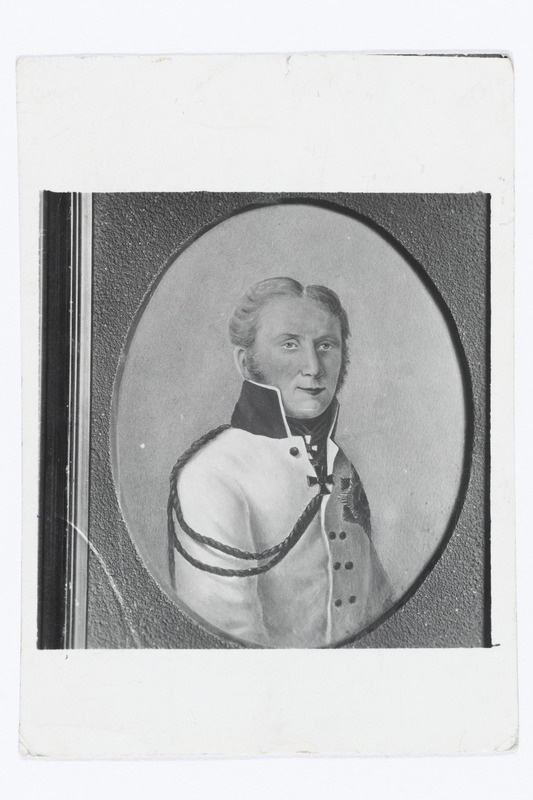

XX 07 – Mohrungen (1/25/07) (KIA)